Luke Frost | |
Paintings
In Five Dimensions: Luke Frost | ||||
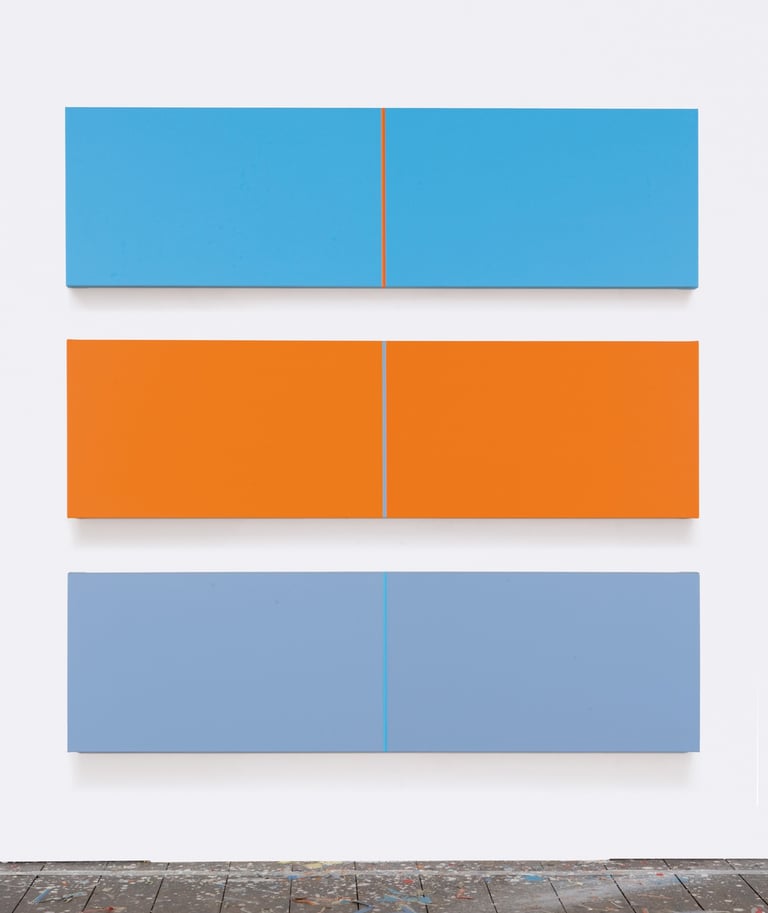
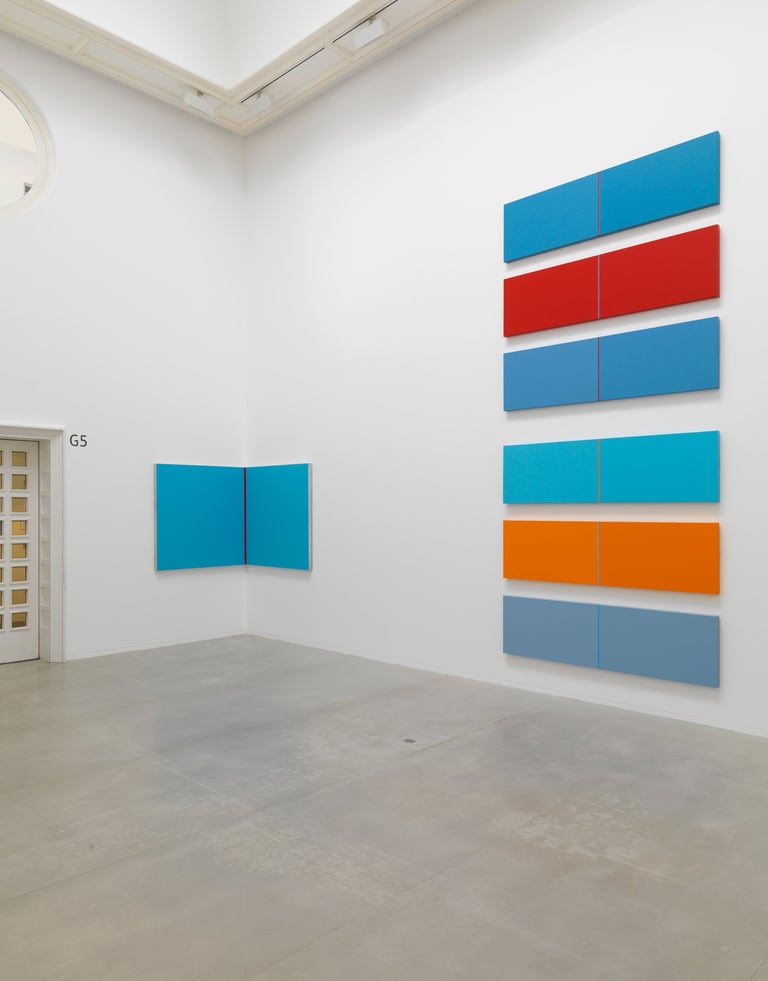
And there are the brush-strokes: it is important that one looks hard enough at this painting that one can start to see them - innumerable horizontal marks. These not-quite-monochromes have a living surface Again and again, we close in on these paintings to see if these are exact and precise straight lines. Invariably, they are so. But not always dead centre: the centre may be at the edge of a volt not the centre of it. Repeatedly we find subtle differences between areas of apparently identical colour. There is a notion of perfection here, but one that is complex, indeed, paradoxically, variable. Things look just so, just right, and then we realise they are not quite as we assumed: they have a movement, a shift, a difference from one part to another. Given his apparent commitment to geometry to what extent can we see Frost as having a connection to the St. Ives painting tradition? Do we see a connection to nature and landscape here? Not directly, but the attention to colour and the relationship of colours and to how light makes colour visible, his concern with space and our place as moving viewers in it, suggest a deeper relationship than is immediately apparent. Does his colour, we may ask, have more to do with colour charts than the nuances of nature? If we look at the later coloured sculptures of Donald Judd we see an approach to colour that owes more to the paint manufacturers colour charts than the traditional colour wheel. Likewise Gerhard Richter in his colour chart paintings has identified and laid out in a deliberate manner the 4000 individual colours that are supposedly the most a human can differentiate. Richter's colour chart paintings lack - almost by definition - any drama. Announcing one by one all four thousand actors in a play hardly whet one's appetite for any of the dialogue. In contrast colour is always dramatic in Frost's work: it is always doing something, always singing stridently, or backing up implacably against another colour. | In his studio Frost has a dozen or so small studies on card, sometimes bent inwards or outwards so he can imagine them as corner paintings. They are much rougher, far less perfect than the finished paintings. But they serve to remind us of how complex those completed paintings are. They do have a special quality of their own. The German painter Blinky Palermo referred to his small blue triangle paintings as being the alarm clock of the spirit. These small studies of Frost's have the same clarion quality. Frost thinks of his volts as electric, but one can also think of them as sound, the noise and its echo or reverberation. Or one could think of them as stones thrown in a pond, the splash and the effect after this as the waves run away in concentric circles and fade. We can imagine the American composer Charles Ives sitting in the bell tower as down below in the square marching bands go by, they are playing the same tune, but because of the laggard speed of sound are always slightly out of time with one another: he relishes the slight dissonance. You can only record these moment by imagining it in your mind's eye - or singing or dancing it, albeit inwardly. In the way that these paintings make us enact a complex dance with colour and shape, they provide a physical equivalent to these intense and precise moments and movements. You tune a drum by tightening the keys on the rim. So it is with the edges in Frost's paintings. So it is with the volts - as perfect and perfectly placed as a small rounded pebble thrown exactly in the centre of a pond - or deliberately just off-centre. This is fine tuning. At a time when the most hyped and bought painting is so noisy and (dare we say it) vulgar, paintings like Luke Frost's act as crucial voices - like those of Vija Celmins or, from a different century, Pieter Saenredam - asking us in a very undemonstrative way to slow down and pay attention to exactly how we see the world, how we experience colour, space and time. © Tony Godfrey 2008 | |||
|
| Home | Selected Works | Tate St Ives 2009 | Studio | Prints | Biog/CV | Exhibitions | Essays | Contacts |
Design © NetPZ 2008 & Luke Frost