Luke Frost | |
Paintings
In Five Dimensions: Luke Frost | ||||
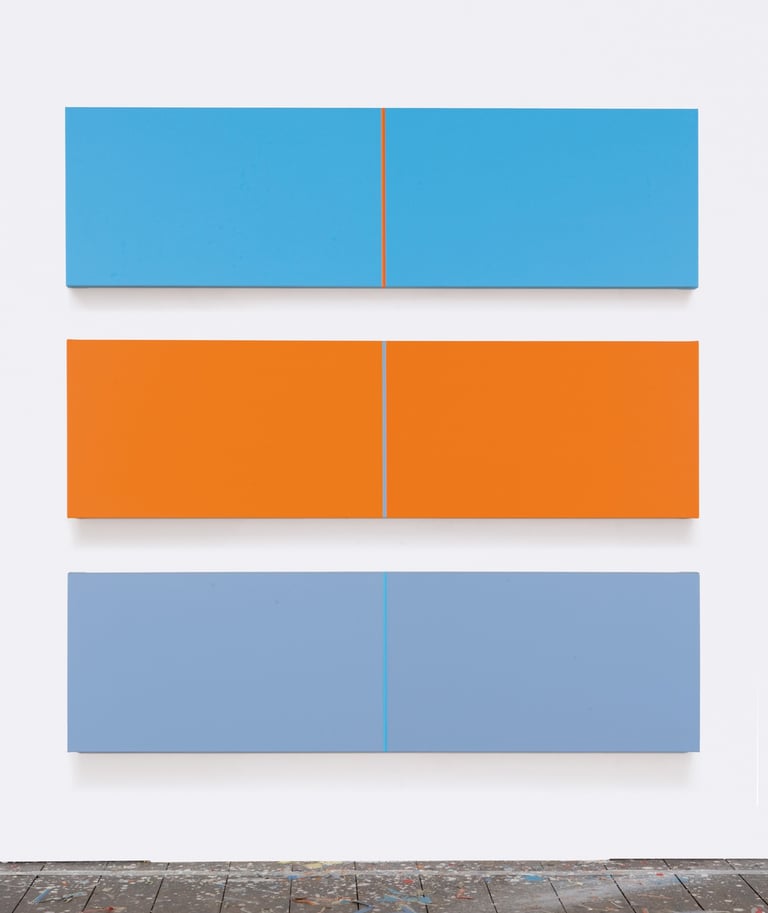
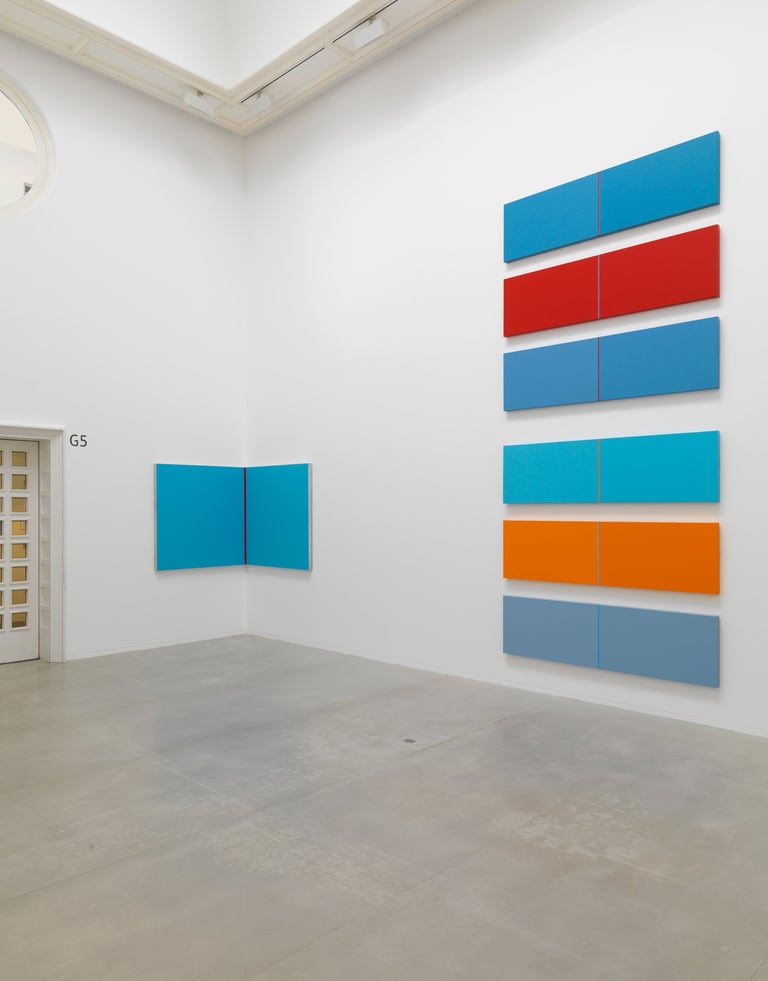
A cursory glance at one of Luke Frost's paintings may well lead us to the mistaken assumption that these are paintings like those made long ago in the Sixties: very flat, abstract paintings concerned with formalist issues only. But this is far from the case: a more thoughtful and responsive walk towards them (notice: no passing glance this) will discover that these are not formalist paintings at all, indeed so far are they not in thrall to flatness that they are (as I shall explain) in fact not two dimensional at all, but operative in at least five dimensions. The most noticeable feature of most of his paintings is the vertical stripe, what Barnett Newman once called a zip and which Frost prefers to call a "volt". A volt refers us to electricity: that which strikes from the heavens or from the power station that one has inadvertently walked into and has lit up the scene in an instance - or just to a faulty, sparking connection in a dark room. It is the way such a volt of lightning or electricity transforms the space around it that matters: it does not sit there pretty like a stripe or bar. As we approach a painting such as 'Volts no. 20', the volt in the middle quickly resolves into two volts and as we get very much closer each of those volts opens up into a pair of blue and mauve volts; finally we realise that the gap between these two double volts is itself the self same width and divided into two slightly different shades of red. Our visual palette has by now gotten highly refined and we further realise that the two blues and two mauves are each subtly different from one another, for they adapt to what we finally realise are the two differing reds of the painting left and right. What has happened? We have been sucked in by the detail. (Interestingly two contemporary painters who create a similar effect are Nigel Cooke and the Indonesian I Nyoman Masriadi - but they use miniaturised human figures to create this pulling-you-in effect.) This experience is through our own body movement in space and time, or in other terms phenomenological. To note such differences is to refine our visual palette: we know the cliché: "Surely not the 96 vintage Chateau Je-ne-sais-quoi with that tinge of blackberry? Surely it must be the vintage 98?" And it is no idle thing: learning to differentiate subtle distinctions is to gain a more complex, richer experience of wine, paintings, the world itself.
| But perhaps still more importantly, with their pulling you into the detail, these paintings are about that opening-up moment - an experience in time - or richness in apparent simplicity. These little surprises, tweaks in symmetry and perception take on unexpected significance. Perhaps the simplest piece of music the great Estonia composer Arvo Pärt's has ever written is his 1976 Für Alina for piano. It is so simple that even I can play it - indeed it is the only piece of piano music I can play. At the critical moment in the score where the simple mathematical sequence, a two note sequence followed by a three note one up to seven and then down again is slightly tweaked at one point by adding a note out of sequence: he inscribes above it in the score a flower, as if to say the music here blooms. It is a moment of transfiguration. Acrylic paint, synthetic material, here blooms too chromatically, momentarily. (What scent would that be were it a flower?) Similarly we could quote William Carlos William's justly famous 1928 poem with its emphasis on a colour moment enlightening a whole scene, giving plangency and purpose to an apparently banal passage in time: so much depends a red wheel glazed
with rain beside the white
| |||
|
| Home | Selected Works | Tate St Ives 2009 | Studio | Prints | Biog/CV | Exhibitions | Essays | Contacts |
Design © NetPZ 2008 & Luke Frost