Luke Frost


Understanding Luke Frost
Matthew Collings


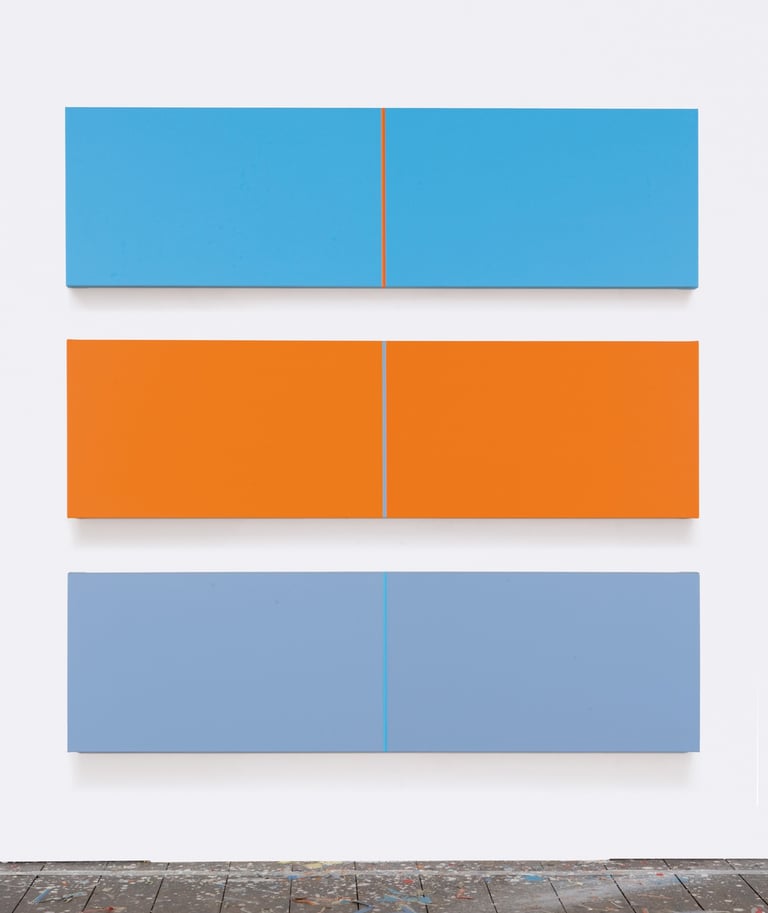
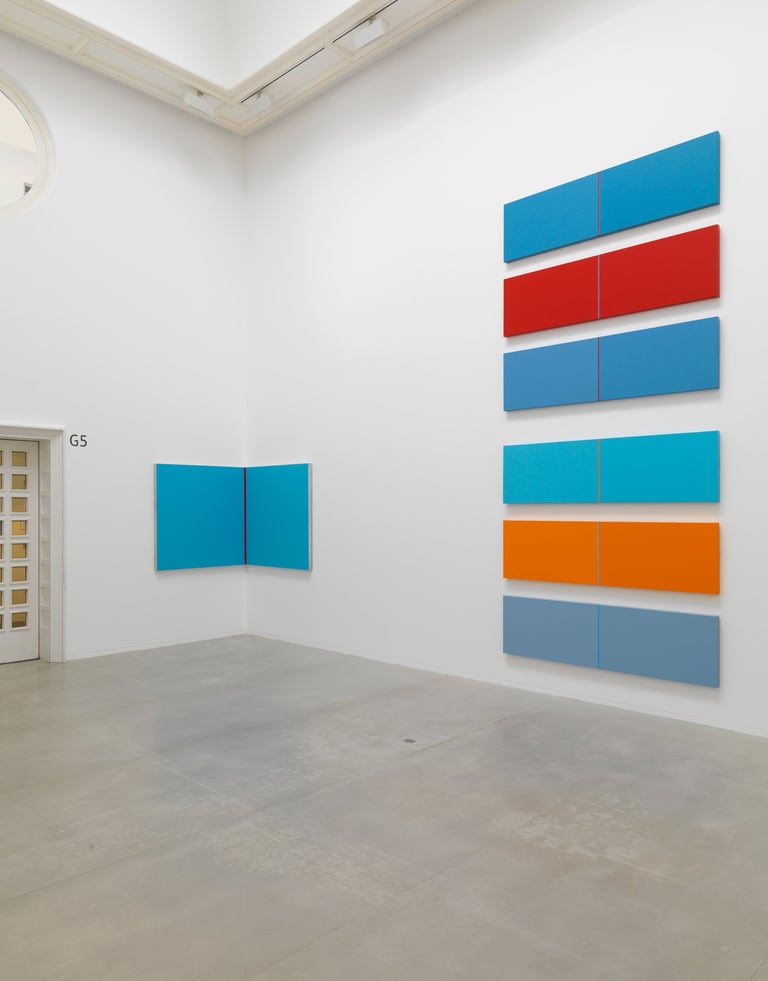
1. The facts. Big paintings -- diptychs (two big squares) -- triptychs (three horizontal long narrow sections) -- small cardboard ones that look like tryouts but have a charm of their own -- plus a right-angle structure using metal instead of canvas.

2. Acknowledged influences: Dan Flavin's neon strip-lights -- the look of art from that era -- the 60s -- Judd and so on. And Neo Geo -- the look that emerged in the mid-1980s in painting in the States and Continental-Europe -- New York, Austria, Germany, Switzerland, France -- Peter Halley, Philip Taaffe, Olivier Mosset, John Armleder and others.

3. The process. He works on a canvas for a while with certain colours, intuitively searching for the right combination. When he thinks he knows what it should be he starts the real work in earnest. He builds up the layers so the colour feels like it's really there and is totally right. It's not just a question of layering the same colour-mix again and again. Sometimes he has to change the shade a bit. The thin lines are done with little brushes and take ages.

4. The result: a look that is both extremely familiar -- art from the past, some decades ago -- and odd - why do this look now? At the same time no questions at all, just acceptance of what you're looking at: a colour effect: a spatial illusion; a great expanse of space and no space at all, just physical flatness.


1. He's been working for a year in Patrick Heron's old studio. The little patches of brown oil paint on one of the walls, preserved by Heron from the time when the space was used by Ben Nicolson, are reminders of visual traditions that play a role in Luke's thought processes even if they're not in the foreground of his mind.

Colour is always light, a metaphor for light, even when all the conscious work that's gone into its presentation is about self containment or self referral, as with the Minimalist artists of the 1960s (who Heron thought were incredibly overrated).

Luke's paintings pay homage to the strange flat narrowness of that type of art, its refusal to be anything other than what it is: an object stripped down and pared back so much that the space around it becomes weirdly electrified. But his paintings do that and something different as well.

The little optical buzz he creates, the wavering effect when a very straight edge of one colour meets a very straight edge of a colour that has the exact same level of vibration but is in an opposite hue, suggests the fun and delight of ordinary existence: the glow of the bay beyond the studio, the light on some wood, the feeling of things constantly in motion, what it's like to be alive.

A light Prussian blue, a certain shade of orange -- a large area of something, a narrow strip of something else. What does it mean? You're taking in a set of impressions, and as you're absorbing them meaning invades. It's impossible to see anything as just itself, you're always relating it to everything else: the more crisply individual the flat colour-areas become in Luke's painting process, the more, on the one hand, the whole object takes its place in a world of objects, and on the other it comes alive because of its strong ability to mirror and reflect all your retained impressions of the effects of light in nature.

Understanding Luke Frost cont >>


Home | Selected Works | Tate St Ives 2009 | Studio | Prints | Biog/CV | Exhibitions | Essays | Contacts


Design © NetPZ 2008 & Luke Frost

Site Map